
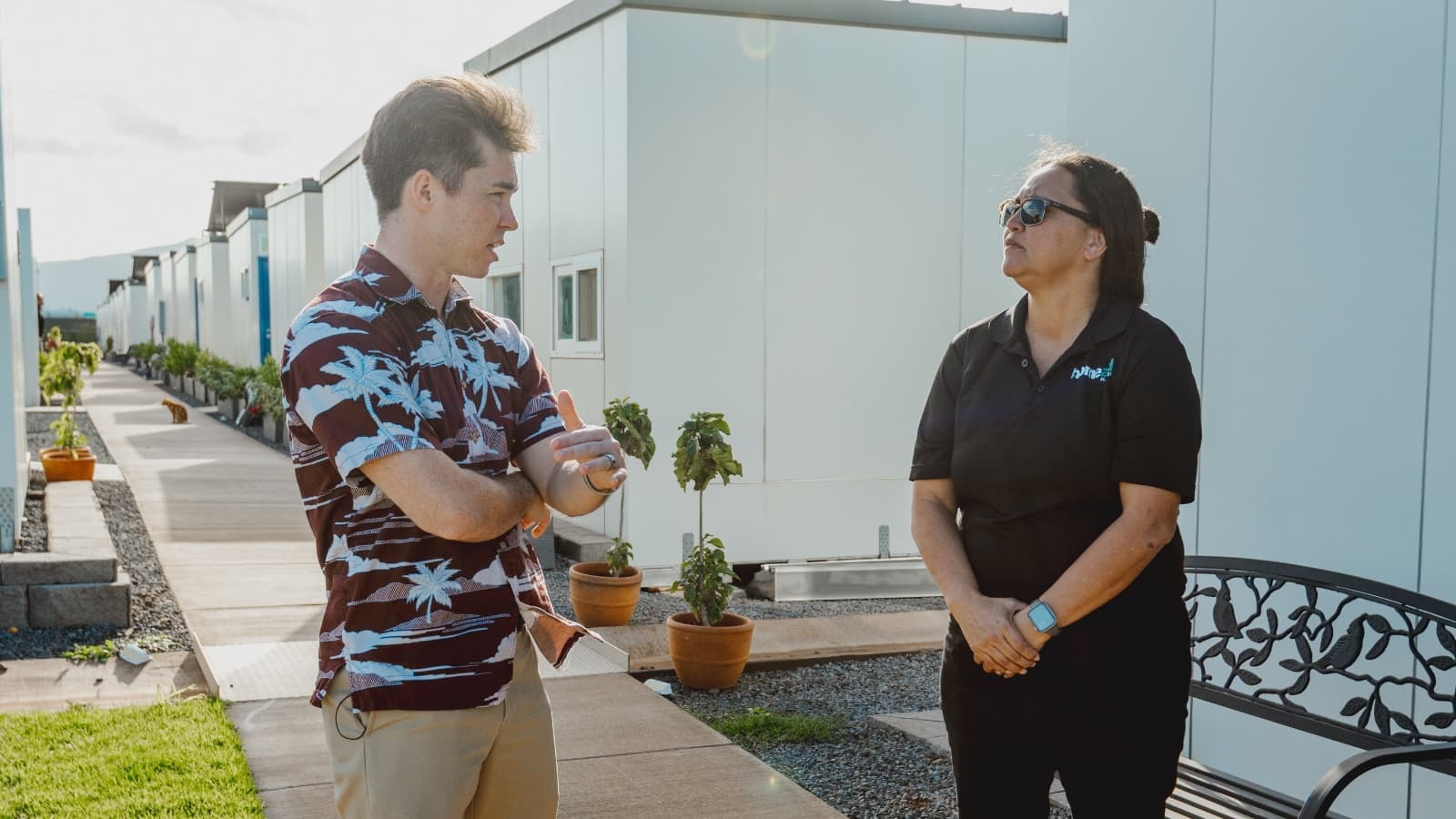
Sterling Higa, co-founder and former executive director of Housing Hawaiʻi’s Future, recently visited Kīpūola Kauhale on Maui, where we walked him through the site and shared how Kauhale Management Services is supporting residents through on-site programs.
Afterward, we sat down to talk story about Hawaiʻi’s housing crisis. It was a candid conversation about what is not working, why affordable housing has become so hard to build, and what needs to change if we are serious about moving forward.
Here are eight takeaways from that conversation.
For a long time, Hawaiʻi had housing that worked for people with the least money.
Single room occupancy units were common. You had your own room, but shared kitchens and bathrooms.
That mattered because kitchens and bathrooms are the most expensive parts of housing. Build fewer of them, and costs go down.
Over time, we made that kind of housing illegal. We added rules, restricted density, and limited what could be built and where.
The lowest cost options disappeared.
The people who depended on them did not.
Hawaiʻi has made it illegal or extremely difficult to build the types of housing people can actually afford.
Kauhale. Duplexes. Accessory dwelling units. Modest multi-story homes.
Even small changes, like allowing an extra story on existing buildings, could significantly increase housing supply without changing the character of neighborhoods.
In other parts of the world, this already exists. Walk through cities in Japan or Europe and you will find two and three story homes everywhere. Not skyscrapers. Just more homes.
If we want more housing, we have to allow more housing.
Think about the rungs on a ladder.
Emergency housing sits at the bottom. Then there is a gap. And then full market rent.
So where do you go if you are stable, but not ready for that next step?
There is nothing in between.
People gain a little stability, and then fall right back. Not because they failed, but because the next step is too far.
And this is not just about the lowest rung. Housing has to exist at every level.
If we do not build enough housing for higher income households, they do not disappear. They compete for the same limited homes everyone else is trying to get, including your grandma’s house.
Without housing at every level, people do not move forward. They get pushed back.
Not everyone on the streets is there for the same reason. Some people are dealing with deeper challenges.
But many are there because they simply cannot afford housing.
If we filled the gap at 30 percent AMI and up to 60 percent AMI, we could move a significant number of people off the streets. More importantly, we could prevent people from getting there in the first place.
There are working families right now who are barely holding on. They have income, but no cushion. One setback, and they are in crisis.
Build enough housing at those levels, and fewer people fall through the cracks.
Today, housing is tightly matched to income. People are expected to pay exactly what they can afford.
The result is that many never build savings. They stay stuck.
But housing should do more than cover costs.
When people have access to lower cost housing, they can stabilize, save, and move forward.
It also challenges a common assumption. Not everyone needs to spend a third of their income on housing.
Deeply affordable housing should help people build up a cushion, not just stay afloat.
Housing did not become expensive overnight. It became expensive over time.
Not because of one policy, but because of a thousand policies.
One rule. Then another. Then another.
Layered together, those decisions made housing slower, more complicated, and more expensive to build.
Kauhale projects have moved forward by carving a path around those barriers, using emergency proclamations to bypass the system.
If a thousand policies make it illegal to build, the only way forward is to find a way around them.
This crisis was built over decades.
What makes it harder now is the belief that nothing can be done. That the system is too complex to change.
But change has already happened. Kauhale exists because people chose to act, to challenge the status quo, and to do something different.
The biggest barrier is not the problem itself.
It is the belief that the problem cannot be solved.
It is easy to focus on what is not working. Most conversations drift toward criticism.
But for the people doing the work, especially in leadership, that is often all they hear.
Sometimes it only takes one message.
“I saw what you did. Good job.”
In a day of a hundred emails, that might be the one that sticks.
If we want change, we have to be willing to encourage it.
Mahalo Sterling for taking the time to talk story with us and share your perspective.
